Your Business Isn’t Short on Opportunities. It’s Losing Them in the Handoff.
There is a frustrating moment that happens in almost every growing business. The marketing starts working. Someone fills out a form, responds to an ad, sends a message, calls the office, or asks for more information. The opportunity is there.
And then the process gets messy.
The information might land in an inbox while another lead comes through Facebook. Someone else receives a text message. A salesperson writes down a reminder to follow up later. Another inquiry gets added to a spreadsheet. Before long, the business has plenty of opportunities—but no clear picture of where those opportunities are going.
The problem isn't always lead generation. Sometimes, it's what happens after the lead arrives.
Your 2026 advantage starts here.
Get the free 7-page AI & Marketing Playbookand turn uncertainty into scalable growth.
The Lead Handoff Is Where Growth Gets Messy
Businesses spend a tremendous amount of time trying to generate attention. They invest in websites, advertising, social media, SEO, referrals, email campaigns, and other strategies designed to get potential customers interested. But generating interest is only the beginning of the customer journey.
What happens next can determine whether that interest becomes an actual conversation. A potential customer might submit a form from your website, send a Facebook message, respond to an advertisement, or call your business directly. If all of those interactions are being managed in different places, your team has to manually connect the dots. Someone has to notice the inquiry, figure out where it came from, determine who should handle it, and remember to follow up.
That might work when you're dealing with a handful of leads. It becomes much harder when your business starts growing. And that's where opportunities begin slipping through the cracks.
More Leads Won’t Fix a Broken Process
When a business isn't generating enough sales, the instinct is usually to look for more leads. More advertising. More traffic. More social media. More outreach.
But what if the business already has opportunities that aren't being handled efficiently?
Imagine spending money to generate a new lead, only for that person to wait hours—or even days—for a response. Imagine someone reaching out through your website and then having to explain the same situation again when another employee calls them. Imagine a salesperson intending to follow up tomorrow, only for the lead to get buried beneath everything else on their to-do list.
Adding more leads to that process doesn't necessarily solve the problem. It can actually make it worse.
Before asking, “How can we generate more leads?”, businesses should also ask, “What happens every time a new lead comes in?”
That question reveals a lot.
Where does the information go? Who gets notified? How quickly does someone respond? Is the lead automatically organized? Can your team see previous conversations? Is there a clear next step? What happens if the customer doesn't respond? And perhaps most importantly, can the business see the entire journey from first contact to closed customer?
When those answers aren't clear, the issue isn't simply sales. It's the system supporting sales.
Speed Matters, But Context Matters Too
Customers have become accustomed to getting information quickly. When someone is ready to learn more about a product or service, they don't necessarily want to wait until someone happens to check an inbox.
But speed alone isn't enough.
A fast response that has no context can still create a poor experience. Customers don't want to explain themselves over and over again. They don't want to receive a generic message that ignores what they just asked about. They want to feel like they're talking to a business that understands where they are in the process.
That's why connected information matters.
When your team can see where a lead came from, what they were interested in, what communication has already taken place, and what the next step should be, the conversation becomes much easier. Your team isn't starting from zero every time someone reaches out. The customer gets a smoother experience, and your team gets the information they need to do their job well.
Your Customer Shouldn't Have to Start Over
Think about the businesses you enjoy working with. They probably aren't memorable because they use the most software. They're memorable because the experience feels easy.
You don't have to repeat yourself. Someone knows what you need. Communication feels organized. The next step is clear. When you have a question, the person helping you has enough context to actually help.
That's what a connected customer journey should accomplish.
A CRM shouldn't simply be a place where a company stores names, phone numbers, and email addresses. It should help the business understand what is happening with each opportunity. When was the person contacted? What did they ask about? Did they schedule an appointment? Did someone follow up? Are they still interested? What should happen next?
The more clearly a business can answer those questions, the easier it becomes to manage growth without relying on memory, scattered notes, or a dozen different platforms.
Automation Should Make Your Business Better, Not Colder
This is also where automation is often misunderstood.
Some businesses worry that automating their follow-up will make the customer experience feel robotic. But thoughtful automation isn't about removing people from the process. It's about making sure important steps don't depend entirely on someone remembering to do them.
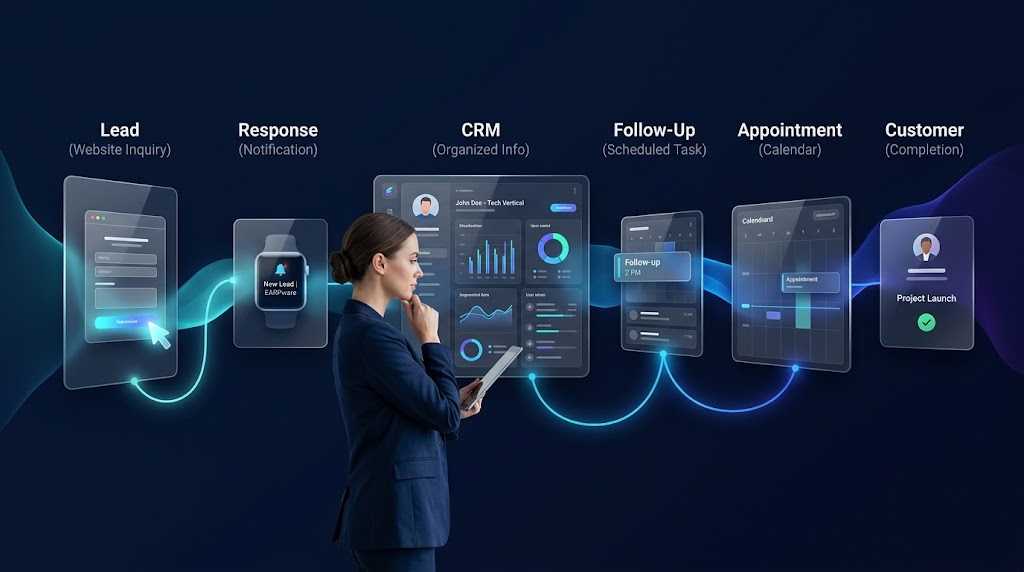
A new lead can receive an immediate confirmation while a team member is notified. A follow-up task can be created automatically. An appointment can be scheduled directly through a calendar. If someone doesn't respond, another reminder can be triggered at the appropriate time. Meanwhile, your team can step in when the conversation requires actual human attention.
The technology handles the repetitive process. Your people handle the relationship.
That distinction matters. The goal isn't to automate the customer. It's to automate the administrative work surrounding the customer so your team has more time to actually serve them.
The Best Systems Make the Business Feel Simpler
A growing business doesn't necessarily need more tools. In many cases, it needs fewer disconnected tools working more effectively together.
When lead capture, communication, CRM, calendars, follow-up, and reporting all live in separate systems, your team spends time moving information instead of acting on it. That's one of the hidden costs of a disconnected tech stack.
A connected system changes the workflow. A customer submits a form, and the information enters the CRM. The appropriate team member is notified. The customer receives a timely response. Follow-up is organized. The conversation is tracked. An appointment can be scheduled. The business can see what happens next.
Instead of asking, “Where did that lead go?”, your team can ask a much better question:
“What should we do next?” That is the difference between having software and having a system.
This Is Where EARPware Comes In
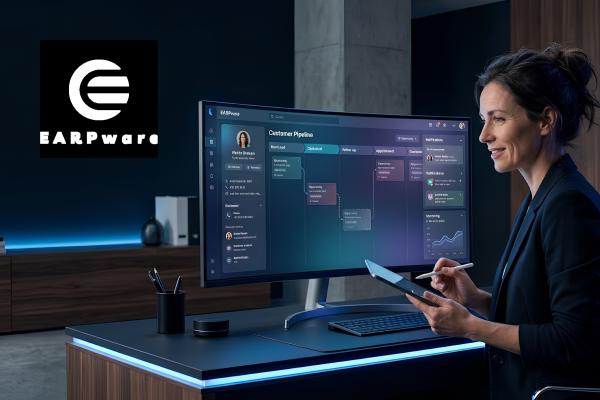
EARPware Connect is designed to bring the moving pieces of the customer journey into one connected business environment. It combines CRM, lead capture, communication, automated follow-ups, calendars, funnels, websites, and other tools that businesses rely on to attract and manage customers.
The goal isn't to give businesses another complicated platform to manage. It's to reduce the number of places where important information can get lost.
Connect can capture leads through forms, landing pages, and funnels, keep conversations organized, automate follow-up through channels such as text and email, and help teams track opportunities through their pipeline. It also provides visibility into the customer journey so businesses aren't forced to piece everything together manually.
And that's an important distinction for EARPware.
The technology isn't the point. The connected experience is. EARPware's broader ecosystem is built around bringing marketing, CRM, automation, websites, lead generation, and growth tools together so businesses can operate with less chaos and more clarity.
Your Real Growth Problem Might Be What Happens After the Lead
It's easy to measure how many leads your marketing generates. It's much harder to measure the opportunities that quietly disappear because nobody followed up, information was misplaced, or a customer had to start the conversation over again. That's why lead management deserves as much attention as lead generation.
A great marketing campaign can create the opportunity. A great website can capture it. A strong salesperson can close it. But there needs to be a system connecting all of those pieces together.
Because a lead isn't the result. It's an opportunity. And the businesses that consistently turn opportunities into customers aren't necessarily the ones generating the most attention. They're the ones that have built a process capable of handling that attention when it arrives.
Your business may not need more leads right now. It may need to get better at keeping the ones it already has.
Stop Losing Opportunities in the Handoff
Marketing should create opportunities. Your systems should make sure those opportunities don't disappear. And your people should have the information and time they need to turn those opportunities into real conversations and lasting customer relationships.
That's where smarter systems make a difference. Not by replacing people. Not by adding more complexity. But by making sure the right information reaches the right person at the right time.
Less chasing. Less guessing. Less lost opportunity.
More connection. More clarity. More growth.
That's the power of a connected business.


