
Your Best Business Knowledge Shouldn’t Live in One Person’s Head
Every business builds knowledge over time.
Some of it is written down in documents. Some lives inside a CRM. Some is buried in email threads, messages, spreadsheets, training materials, and shared folders. And a surprising amount lives nowhere except inside people's heads.
Employees learn through experience. They discover what customers usually ask. They learn which processes work, which mistakes to avoid, who handles specific situations, and what needs to happen next.
That knowledge becomes incredibly valuable. But when it isn't documented, organized, or accessible to the rest of the team, the business has a problem.
The company may have years of experience, but accessing that experience still requires asking the person who remembers it. That's not a scalable way to operate.
Your 2026 advantage starts here.
Get the free 7-page AI & Marketing Playbookand turn uncertainty into scalable growth.
When One Person Becomes the Answer to Everything
You can usually spot this problem by listening to the questions employees ask each other.
“Who handles that?”
“Where can I find that file?”
“What did we tell this customer last time?”
“How do we normally do this?”
“Can you show me how you did that?”
“Who should I send this to?”
Those questions aren't necessarily signs of a bad team. In fact, they often mean the opposite. Your employees are trying to do their jobs correctly. The problem is that the answers aren't always easy to find.
As a business grows, informal knowledge sharing becomes harder to maintain. What worked with five employees may not work with twenty. The owner can't answer every question. The manager can't train everyone personally. And experienced employees can't constantly stop what they're doing to explain the same process over and over again. Eventually, the business starts paying for the same knowledge twice: once when someone learns it, and again every time someone else needs to learn it.
Experience Should Become a Business Asset
Experience is one of the most valuable things a company can have.
An employee who has worked with customers for years may understand situations that a new employee couldn't learn from a basic training manual.
A salesperson may know exactly what questions to ask because they've handled hundreds of conversations.
A manager may know how to solve a recurring operational problem because they've seen it happen repeatedly.
You don't want to replace that experience. You want to capture it. When experienced employees document processes, decisions, answers, and best practices, their knowledge can become something the entire organization benefits from.
That's when experience starts becoming a business asset instead of a personal advantage. The goal isn't to turn every employee into a walking instruction manual. It's to make sure important knowledge doesn't disappear simply because the person who knows it isn't available.
What Happens When Your “Go-To Person” Is Gone?
Consider how much disruption can come from one person being unavailable. A customer needs an answer, but only one employee knows the history. A new team member needs training, but the person who normally handles it is busy. A recurring task needs to be completed, but the process was never documented. A manager wants to understand why something is being done a certain way, but the explanation exists only in an old conversation.
None of these situations necessarily create a crisis on their own. But together, they create friction. Employees spend more time searching. Managers spend more time answering questions. New hires take longer to become productive. Customers may experience delays. And experienced employees become bottlenecks simply because everyone depends on them.
That's when a knowledge problem becomes an operational problem.
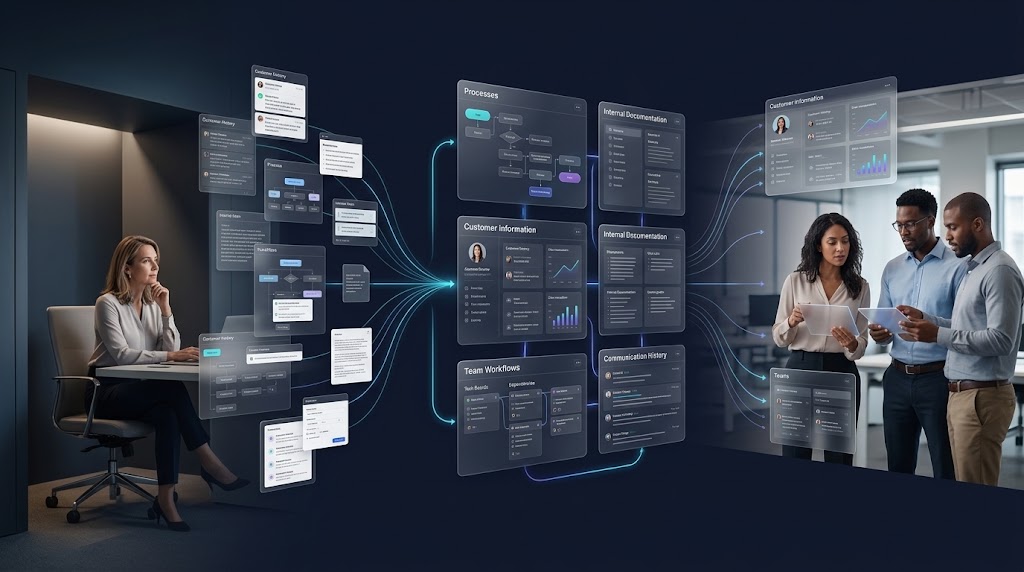
Your Business Needs a Memory
A strong business shouldn't rely entirely on people remembering everything. People are supposed to think, create, solve problems, build relationships, make decisions, and bring expertise to their work. Systems can help remember the details.
That could mean keeping customer information organized, documenting repeatable processes, maintaining communication history, creating internal resources, tracking tasks, organizing files, or making important information easier for the right people to access.
The point isn't to create more documentation for the sake of documentation. The point is to make the business easier to understand. When someone joins the team, they should have somewhere to start. When someone takes over a responsibility, they shouldn't have to rebuild the process from scratch. When an employee is unavailable, the business shouldn't suddenly lose access to everything that person knew.
A business with a memory can keep moving.
Documentation Doesn't Have to Feel Like Homework
One reason businesses avoid documenting their processes is that it sounds like a massive project. Create manuals. Write procedures. Build training libraries. Document every possible scenario.
It can quickly become overwhelming. But effective knowledge management doesn't have to happen all at once. Start with the things people ask about repeatedly. Document the process that only one person knows. Save the answer to the question your team gets every week. Create a simple checklist for a recurring task.
Keep important customer and communication information in a place the appropriate team members can access. Then improve it over time. The goal isn't to document everything. It's to stop making your team rediscover the same information repeatedly.
Technology Should Help People Share What They Know
This is where technology can make a meaningful difference. The right technology doesn't replace the experience of your employees. It gives that experience somewhere to live. A connected business environment can help organize customer information, communication, workflows, tasks, documents, processes, and other important business details so employees don't have to rely on memory alone. And increasingly, AI can assist with finding, organizing, summarizing, and working with information.
But the human being still matters. Your employee knows the customer. Your manager understands the situation. Your team knows the business.
Technology simply makes it easier for that knowledge to be available when it is needed. AI should be your assistant, not your identity. The same principle applies to business systems.
They should support your people, not replace the knowledge, judgment, and relationships that make your business valuable.
This is one of the reasons EARPware takes a broader approach to business technology.
A growing company rarely has just one system. It has a CRM. A website. Marketing tools. Communication platforms. Automation. Calendars. Social media. SEO. Customer information. Internal processes. And countless pieces of information moving between them.
The challenge isn't simply having those tools. It's making sure the business can actually operate with them without creating another layer of complexity.
EARPware brings different parts of business growth and operations into a connected ecosystem, helping businesses manage the systems behind marketing, customer relationships, websites, automation, and day-to-day growth.
The goal isn't to make technology the center of the business. It's to give the people running the business a better environment to work in. Because when information is easier to access and processes are easier to understand, your team can spend less time searching for answers and more time doing the work that actually requires them.
Build a Business That Can Teach Itself
A scalable business shouldn't require every new employee to learn everything through trial and error.
It shouldn't require managers to repeat the same instructions every month. It shouldn't depend on one person remembering why something was done a certain way. And it shouldn't lose valuable knowledge every time someone changes roles.
The businesses that scale well aren't necessarily the ones where everyone knows everything. They're the ones where important knowledge can move. From experienced employees to new employees, conversations into systems, individual experience into shared processes and lessons learned into better ways of working.
That's how a business becomes stronger without becoming more dependent on a few key people.
Your People Are the Advantage. Make Their Knowledge One Too.
Your best employees are valuable because of what they know. They understand your customers. They solve problems. They make decisions. They build relationships. They bring judgment that can't simply be copied into a software platform.
But your business shouldn't make them carry the entire organization's memory. Give their knowledge somewhere to go. Document what matters. Connect the information your team relies on. Create systems that make processes easier to understand.
Use technology to support the people who already know how to make your business work. Because the goal isn't to build a business that doesn't need its people.
It's to build a business where its people can do their best work without having to carry everything in their heads. Your employees should be the advantage. Their knowledge should be an advantage too.


