
THE AD BUDGET LEAK NOBODY SEES: WHY GOOD CAMPAIGNS STOP WORKING
There is a frustrating moment every business owner who runs ads eventually experiences. The campaign starts strong. Leads come in. The numbers look promising. Everyone is happy. Then, slowly, something changes. The cost per lead starts creeping up. Fewer people click. The same ad that worked two weeks ago suddenly feels invisible. The budget is still being spent, but the results aren't what they used to be.
And the first reaction is usually the same: We need a new ad. Sometimes that's true. But often, the bigger problem is that the campaign wasn't adapting fast enough.
Digital advertising doesn't happen in a vacuum. Customer behavior changes. Competitors change their offers. Trends shift. An audience that responded to one message last month may respond differently today.
Consider a local home services company running Facebook and Instagram ads for emergency repairs. One ad performs exceptionally well because homeowners are actively looking for help. The company increases the budget and expects even better results. But after a few weeks, performance starts dropping. The business owner sees the numbers and assumes the ad is broken.
The reality may be much simpler: the audience has already seen the message too many times, another competitor has entered the market with a stronger offer, or a different segment is now responding better.
The problem isn't necessarily the campaign. The problem is the feedback loop. If the business only reviews performance once a week—or worse, once a month—it may spend thousands of dollars learning something that could have been recognized much earlier.
The Real Cost Isn't Always the Ad Spend. This is where advertising gets interesting. The money lost isn't only the money spent on an underperforming ad. It's the opportunity cost attached to it.
Imagine a business spending $3,000 a month on digital advertising. If one campaign gradually becomes less effective and nobody catches it for three weeks, the business isn't just losing ad dollars.
It's losing potential conversations, appointments, sales and customers that could have been generated from a better-performing campaign. That is why real-time optimization matters. The businesses getting smarter about advertising aren't simply asking, "How much did we spend?" They're asking, "What is the data telling us right now?"
Your 2026 advantage starts here.
Get the free 7-page AI & Marketing Playbook and turn uncertainty into scalable growth.
What This Looks Like in a Real Business
Take a growing dental practice. The practice launches three campaigns: one for new patient exams, one for cosmetic services and another for an Invisalign consultation.
At first, the cosmetic campaign gets the most attention. But after several weeks, the data begins showing something different. The Invisalign campaign is generating better-quality leads and appointments, while the cosmetic campaign is producing plenty of clicks but fewer actual consultations.
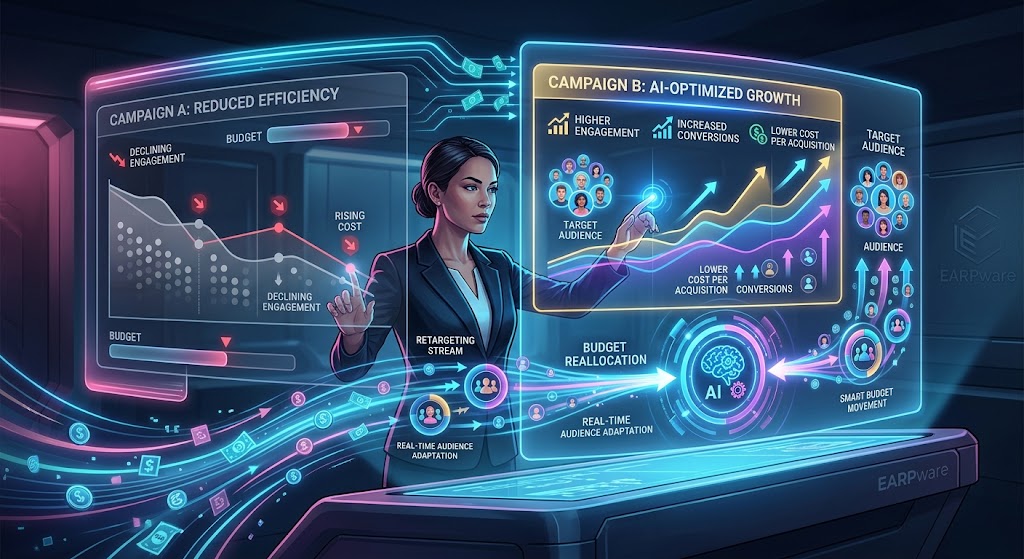
A traditional approach might leave everything running until someone notices the difference during a monthly review. A smarter approach recognizes the shift earlier and reallocates attention and budget toward the campaign producing stronger business results.
That's the difference between running ads and managing advertising intelligently.
Don't Chase Every Click
There is another lesson here that businesses often overlook. More traffic does not automatically mean more growth.
A campaign can generate thousands of clicks and still produce disappointing revenue. Another campaign may receive fewer clicks but bring in customers who actually buy. That is why advertising needs to be connected to the bigger customer journey. The strongest campaigns don't exist simply to generate impressions. They connect the right audience with the right offer and give the business a way to understand what happens after the click.
In other words, attention is not the finish line. Revenue is.
A Different Way to Manage Advertising
This is where AdCommand becomes interesting.
Instead of treating advertising as something that gets launched and then manually checked from time to time, AdCommandis designed to continuously monitor performance signals and make adjustments as campaigns evolve. It can analyze audience behavior, refine underperforming campaigns, optimize budgets and help scale what is actually working.
That difference matters.
A business owner shouldn't have to wake up every morning wondering which ad needs to be turned off, which audience needs attention, or whether yesterday's budget should be moved somewhere else. The system should help surface those decisions.
Make Your Ad Budget Work Smarter
Advertising shouldn't feel like throwing money into a machine and hoping something comes back. Your campaigns are producing information every day. The real advantage comes from actually using that information.
AdCommand gives businesses an AI-powered approach to monitoring, optimizing and improving their advertising so campaigns can adapt as performance changes. The question isn't whether your business should be running ads.
The better question is: Are your ads learning fast enough?
Your advertising budget should work as hard as your business does. Instead of waiting for campaigns to underperform for weeks before making a change, use intelligent optimization to identify what is working, adjust what isn't, and put your budget where it has the strongest opportunity to perform.
Ready to stop guessing and start commanding your advertising?
Discover AdCommand and see how smarter advertising can turn your budget into a growth engine.


